Ads
Rogue circular DNA reveals an Achilles heel in lethal cancer tumors
khoảng 4 giờ trước
00ROGUE CIRCULAR DNA REVEALS AN ACHILLES HEEL IN LETHAL CANCER TUMORS
Imagine our body as a grand library, where instructions for constructing and maintaining life are neatly bound into encyclopedia volumes arranged across twenty-three pairs of shelves called chromosomes. Normally, whenever a cell divides, a meticulous molecular librarian photocopies each volume faithfully and distributes identical sets to both daughter cells. Yet inside aggressive cancer tumors, this orderly world breaks down as rogue pages tear away and curl into chaotic circular loops adrift outside the chromosomal shelves.
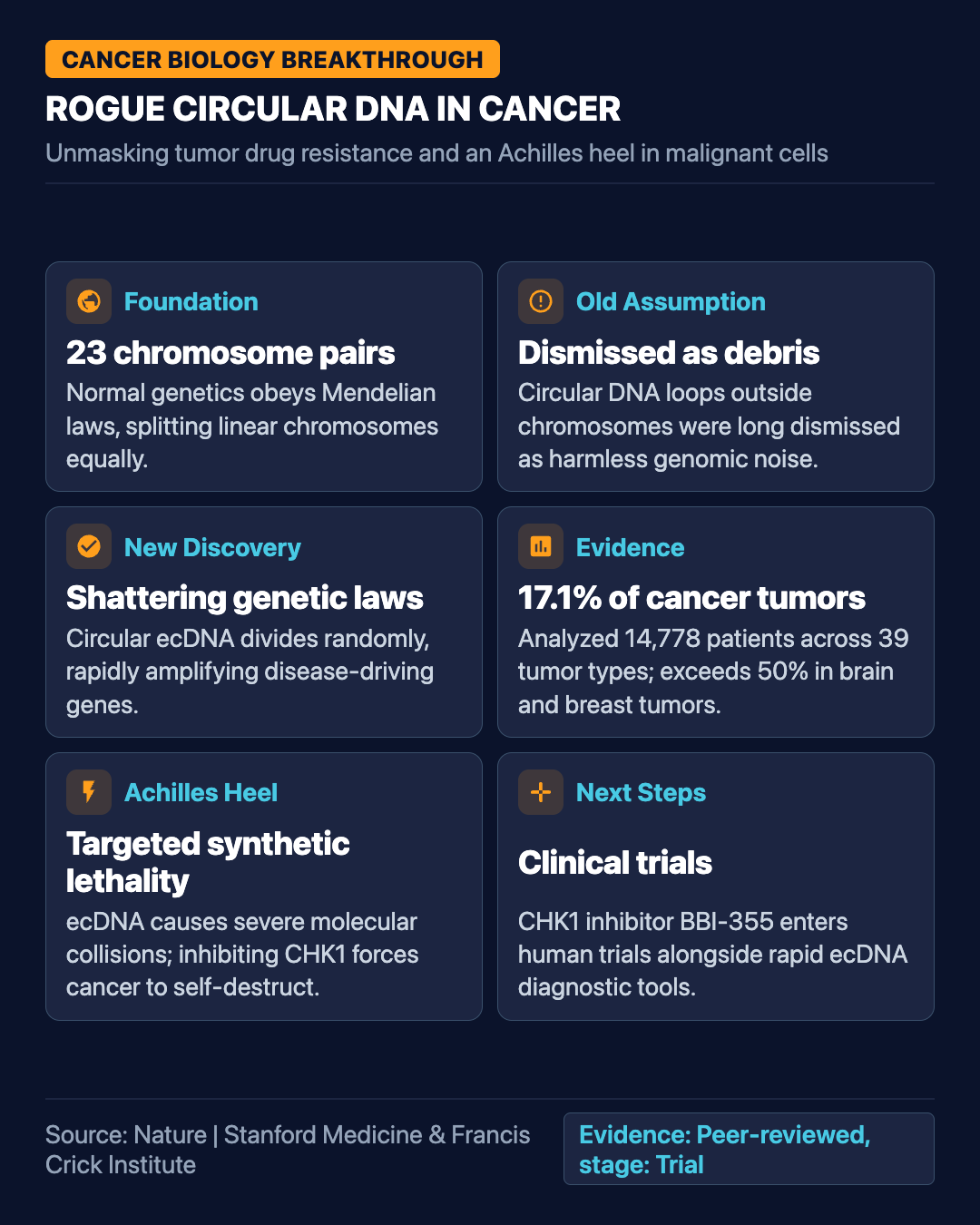
On November 6, 2024, an international scientific alliance named eDyNAmiC, led by Stanford University and the Francis Crick Institute, published a landmark trio of back-to-back studies in the journal Nature. The researchers unmasked one of the deepest mysteries in cancer biology: detailing how these extrachromosomal DNA loops drive aggressive tumor evolution and drug resistance, while uncovering a fatal molecular Achilles heel that allows medicine to destroy them.
Note – Extrachromosomal DNA: Small circular fragments of genetic material floating freely outside the cell main linear chromosomes. They function like bootleg notepads copying dangerous growth instructions outside normal cellular regulation.
WHAT WAS THIS PROBLEM ORIGINALLY?
For more than a century, modern biology operated under the belief that cancer evolution follows classical Mendelian inheritance. Standard medical dogma held that cancer-driving mutations reside squarely on linear chromosomes, divided equally between daughter cells during mitosis. Although scientists caught glimpses of peculiar microscopic dots outside chromosomes as early as the 1960s, they were long dismissed as harmless genomic trash or inconsequential biological noise.
Note – Mendelian inheritance: The fundamental rules describing how traits pass from parents to offspring or from mother cell to daughter cells. It assumes genes reside on paired chromosomes that divide in an orderly, symmetrical manner during cell division.
Meanwhile, oncologists faced a heartbreaking paradox in clinical care: patients receiving cutting-edge targeted therapies often experienced dramatic tumor shrinkage, only for their disease to roar back months later, entirely resistant to every available drug. What biological engine allowed malignant cells to reshape themselves far faster than genetic rules predicted?
WHAT HAS CHANGED COMPARED TO BEFORE?
The breakthrough reveals that cancer cells break the rulebook entirely. The new findings published in Nature show that these free-floating circular loops, known as ecDNA, are cancer ultimate rapid-evolution tool. Lacking centromeres—the biological handles that chromosome-sorting spindles grab onto during cell division—ecDNA particles are parcelled out randomly and unevenly when a cell divides.
One daughter cell might receive hundreds of copies loaded with potent cancer-driving genes, while its sister receives none. This genetic lottery fosters extreme diversity within the tumor. When doctors introduce therapies that eradicate standard cancer cells, rare cells harboring dense clusters of drug-resistant ecDNA survive and multiply aggressively. Furthermore, the team proved that separate ecDNA species do not travel alone; they actively cluster together during division, ensuring that cooperating pairs of harmful genes pass down intact to future generations.
Note – Oncogene: A gene that normally helps cells grow and divide, but when mutated or multiplied excessively, acts like an accelerator pedal stuck to the floor, driving uncontrolled proliferation.
HOW DID SCIENTISTS DISCOVER THIS?
To reach these paradigm-shifting conclusions, the international team conducted a genomic investigation of unprecedented scale. They evaluated whole-genome sequencing datasets from 14,778 cancer patients across 39 distinct tumor types within Genomics England 100,000 Genomes Project.
The peer-reviewed analysis revealed that 17.1% of cancer tumors carry ecDNA, representing roughly one in every six patients. In particularly lethal malignancies such as glioblastoma brain tumors or HER2-positive breast cancers, ecDNA prevalence exceeded 50%. Patients whose tumors tested positive for ecDNA experienced significantly higher metastasis rates and noticeably shorter overall survival times than those without.
Crucially, researchers uncovered a fatal design flaw hidden inside this chaotic machinery. Because cancer cells demand relentless growth, gene-reading enzymes on ecDNA loops churn at maximum speed around the clock. This creates molecular gridlock: enzymes reading genetic code and machinery duplicating DNA collide at high speeds, triggering severe internal damage.
Note – Transcription-replication conflict: A microscopic collision that occurs when cellular machinery reading a gene to produce proteins crashes into machinery copying the DNA strand. It resembles two express trains hurtling toward each other on a single narrow railway track.
To keep from tearing themselves apart during these collisions, ecDNA-bearing tumors rely heavily on an emergency checkpoint protein called CHK1 to clear traffic jams and mend broken strands. When scientists administered an oral CHK1 inhibitor designated BBI-2779 to mice with ecDNA-driven gastric tumors, it deactivated this molecular traffic warden. Collisions spiraled into widespread DNA catastrophe, forcing malignant cells to self-destruct while leaving normal cells unharmed.
Note – CHK1 kinase inhibitor: A compound that blocks a vital checkpoint protein responsible for pausing cell division when DNA damage occurs. Without this safety pause, severely damaged cancer cells collapse into programmed cell death.
Note – Synthetic lethality: A treatment strategy exploiting two linked vulnerabilities. The presence of circular ecDNA alone does not kill the cell, and mild inhibition of the checkpoint protein does not harm healthy cells, but combining both triggers total destruction of malignant cells.
HUMANITY SIGNIFICANCE AND THE ROAD AHEAD
This discovery marks a turning point in the global effort to conquer cancer. Rather than chasing individual fleeting mutations that malignant tumors routinely outsmart, oncology can now target a universal biophysical vulnerability governing one in six cancer patients worldwide. Millions of individuals confronting aggressive, recurrent, or treatment-resistant cancers stand to benefit directly if this therapeutic strategy proves successful.
Nevertheless, the journey from laboratory bench to clinical bedside requires patience. Although an optimized human CHK1 inhibitor named BBI-355 has advanced into early-phase clinical trials, researchers emphasize that broader therapeutic adoption remains years away. Scientists must carefully determine optimal dosing, verify safety profiles over extended periods, and investigate whether tumor cells might develop alternative evasive pathways. The next immediate steps involve completing phase one and two human trials while developing rapid diagnostic tools to detect ecDNA at initial cancer diagnosis.
SOURCES
Nature – Origins and impact of extrachromosomal DNA – https://doi.org/10.1038/s41586-024-08107-3
Nature – Enhancing transcription–replication conflict targets ecDNA-positive cancers – https://doi.org/10.1038/s41586-024-08169-3
Nature – Coordinated inheritance of extrachromosomal DNAs in cancer cells – https://doi.org/10.1038/s41586-024-08106-4
National Cancer Institute – Cancer Grand Challenges Team Finds Way to Attack Extrachromosomal DNA – https://www.cancer.gov/news-events/cancer-currents-blog/2024/ecdna-cancer-chk1-inhibitor
0 comments
Ads
Related Posts
Ads